

Your traffic didn’t disappear because of Google
It disappeared because your signals were already broken.

THE TRUST SIGNAL · ISSUE 04
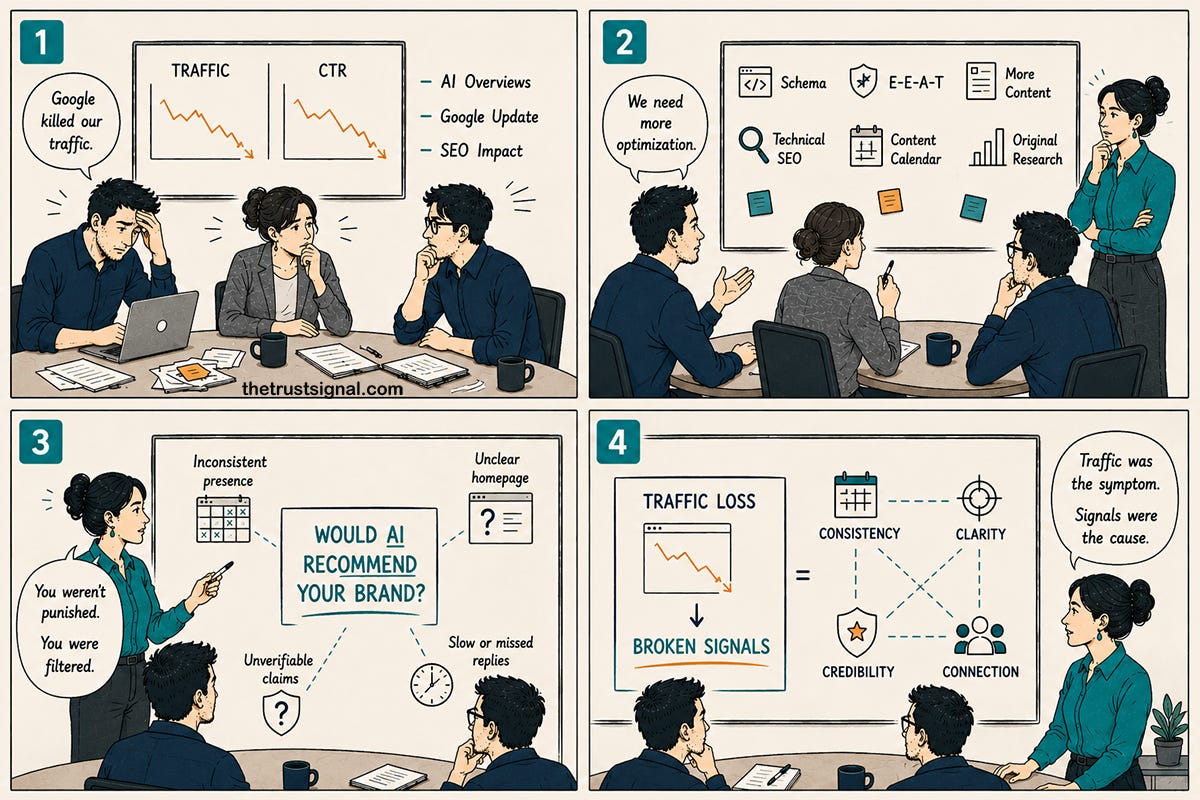
There is a particular kind of panic moving through B2B marketing right now.
Traffic is down. Click-through rates are falling. Google’s AI Overviews are answering questions on the results page without anyone visiting your website, and the awareness-stage content that took months to build is now being consumed without attribution, without visits, and without the relationship those visits used to start.
The panic is understandable. The diagnosis is wrong.
Most brands experiencing significant traffic losses are treating this as a technical problem, an algorithm that changed, a platform that shifted the rules, a visibility problem to be solved with better SEO or more structured data. And yes, those things matter. But they are the wrong starting point.
Because the traffic didn’t disappear because Google changed.
It disappeared because a system that reads trust signals decided, quietly and without appeal, that your brand wasn’t trustworthy enough to confidently recommend.
The shift everyone is describing. The one nobody is naming
The conversation around AI Overviews keeps landing on the same list: fewer clicks, lower CTR, deprioritized informational content, scraping without compensation. These are real consequences. But they describe what is happening, not why it is happening to some brands far more than others.
The brands absorbing the most damage from this shift are not the ones with the worst content. They are the ones whose trust signals were already fragmented, inconsistent messaging across platforms, unverifiable claims on their about page, sporadic presence that surged around launches and went quiet between them, enquiries that waited too long for a reply.
AI did not create those problems. It made them visible.
Here is the distinction that matters: Google, in its original form, asked whether your page was relevant. AI systems ask whether your brand is trustworthy enough to recommend. Relevance and trust are not the same problem. The industry spent fifteen years optimizing for relevance, and that optimization is now worth considerably less than it was.
The brands that are not panicking right now are not better at SEO. They are better at trust.
You weren’t punished. You were filtered
There is a meaningful difference between being penalized and being filtered out. Google’s AI Overviews are not punishing brands that broke rules. They are synthesizing answers from sources whose patterns add up to something the system can confidently cite. Brands that read as inconsistent, unclear, or unverifiable do not make that shortlist.
Think about what AI systems are actually reading. Your posting history, and whether it shows a brand that shows up on a decided rhythm or only when something is launching. Your homepage, and whether a stranger can understand what you sell in eight seconds. Your claims, and whether any of them can be independently verified. Your presence across platforms, and whether four different versions of your brand are being read as four separate entities.
Every one of those signals was available before AI Overviews launched. Your audience was already reading them. The algorithm is simply the first system to read them at scale, without human goodwill, without the benefit of the doubt, and without the context you would provide if someone asked you to explain.
Four questions. Before the strategy document
Open your posting history for the last twelve months and mark every week you posted something. Then mark every week something was launching. If those two sets of weeks are the same weeks, your brand has been present when it needed something, and absent when it didn’t. That pattern is legible to AI. It is also legible to your audience.
Open your homepage in an incognito window. Set a timer for eight seconds. Close the tab. Without looking back: what does your brand sell, who is it for, and what should a visitor do next? If you cannot answer all three from memory, a stranger cannot either. Neither can an AI system trying to decide whether to recommend you.
List the three most prominent claims on your about page. For each one: could a stranger verify this without taking your word for it? Industry-leading. Award-winning. Trusted by thousands. If none of them survive that question, your credibility signal is broken.
Find your last five customer or prospect enquiries. When did they arrive. When did they receive a reply. If the average is more than 48 hours, or any went unanswered, your brand is demonstrating, through its behavior, that it is not reliably present.
If any of those four questions produced an answer you would rather not examine, that is where the work starts. Not with the content calendar. With the behavior the content calendar was built on top of.
The early-mover advantage in this environment belongs to the brands that stop asking how to get more visible and start asking whether, if they had visibility, AI would trust them enough to recommend them.
Those are different questions. Only one of them leads to a repair that lasts.
The Trust Signal investigates the four signals that determine whether AI systems recommend your brand - Consistency, Clarity, Credibility, and Connection.
Next: Blue links didn't die. Their role changed, and what that means for your evidence layer.