

Your brand tells the truth even when you don't
The gap between what you mean and what the evidence says

THE TRUST SIGNAL · ISSUE 01
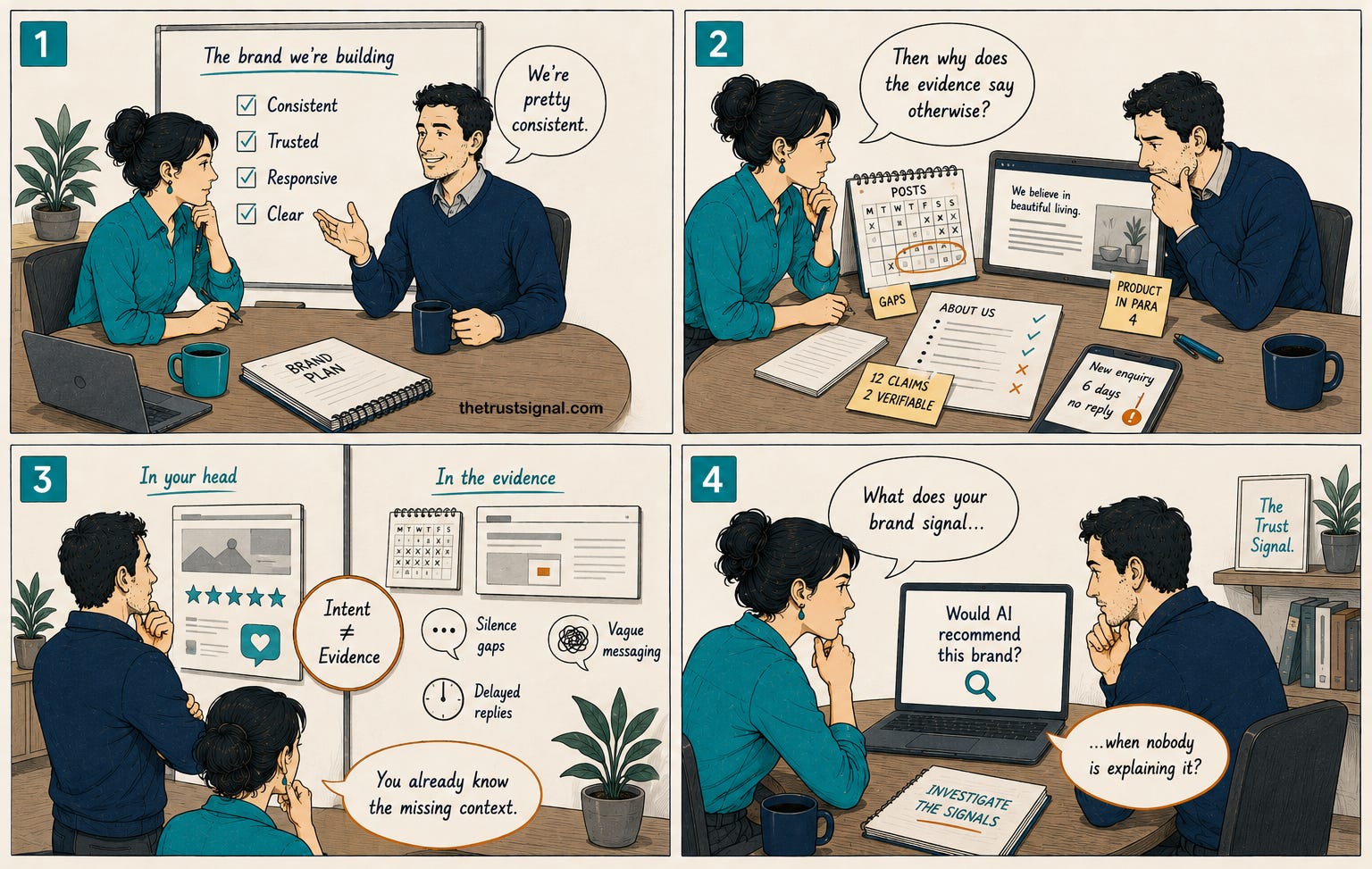
There is a version of your brand that exists in your head.
It shows up consistently. It communicates clearly. Its claims are backed by evidence. It responds promptly and generously. It is the brand you intended to build and, in your mind, largely have.
Then there is the brand that exists in the evidence.
The one AI systems read when your ideal client asks for a recommendation. The one that has a posting history with gaps your audience has learned not to expect you to fill. The homepage that communicates your philosophy clearly and your product only in paragraph four. The about page with twelve claims, two of them verifiable. The enquiry that waited six days for a reply.
These are not the same brand.
The gap between them is not dishonesty. It is proximity. You have been close to this brand for long enough that you stopped being able to read it as a stranger would. You fill in the gaps automatically. You know what the vague claim means. You understand the process behind the friction. You remember why the newsletter stopped going out.
A stranger doesn’t have any of that.
Neither does an AI system.
AI reads what is literally, demonstrably, verifiably there. Not what you meant. Not what you’d explain if asked. What the evidence shows.
This is why brands that have invested years of careful work can still be invisible to AI recommendation systems. Not because the work wasn’t real. Because the signals the work produced, the patterns of behaviour across every touchpoint, don’t add up to a brand an AI system can confidently recommend.
The investigation starts with one question: what does your brand signal when no one is explaining it?
This newsletter exists to help you answer that question, one signal at a time, week by week, with enough specificity that you can apply it to your own brand the same day you read it.
Next: the four signals AI reads, and which one most brands break first.