

The Trust Signal Mystery · Chapter One
The Crime Scene Or The Curious Case of the Vanishing Business

If a business disappears and no algorithm noticed - was it ever really there?
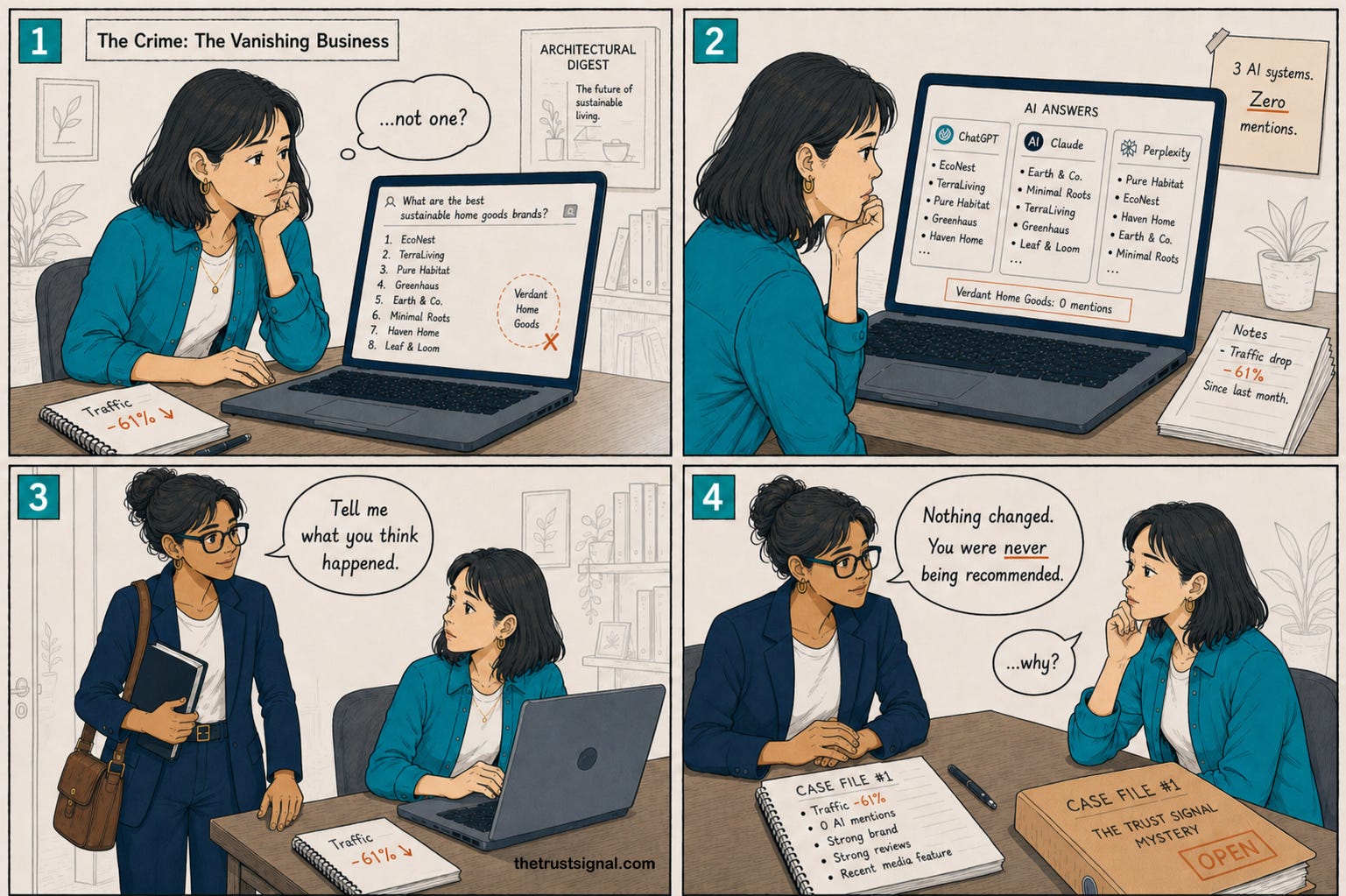
CASE FILE #1
DATE: Tuesday, 9:47 AM
LOCATION: Sarah Chen’s Home Office, Portland
STATUS: Crime Discovered
DETECTIVE: Esmé Tale, Trust Signal Investigator
INCIDENT: Business owner discovers 61% traffic decline despite glowing reviews, 47,000 Instagram followers, and a recent Architectural Digest feature. Three AI systems consulted. Zero mentions. Investigation requested.
I. The Scene of the Crime
The coffee had gone cold. This was, in hindsight, the first clue.
Not the cold coffee itself, cold coffee is merely evidence of distraction, and Sarah Chen was frequently distracted. It was the fact that she hadn’t noticed. She had been staring at the same spreadsheet for forty minutes with the fixed intensity of someone trying to read a foreign language by sheer force of will, and the numbers still refused to cooperate.
Sarah was the founder of Verdant Home Goods, a sustainable storage brand she had spent four years building with the kind of careful, methodical devotion usually reserved for restoring antique furniture or raising particularly anxious children. Her products were beautiful. Her customer reviews were the kind that made you feel briefly optimistic about humanity. Three months ago, Architectural Digest had called her brand “the future of sustainable living,” which she had screenshot, printed, framed, and hung beside the door so she could see it every morning on the way to her desk.
The same desk where she now sat, confronting numbers that had been moving in the wrong direction for six months, trying to identify what, precisely, had been stolen from her.
Because that is what it felt like. A theft. Expertly executed. Entirely silent. The kind that leaves no broken windows and no obvious point of entry, just a slow, creeping absence where something valuable used to be.
No blood. No bodies. No ransom note. Just absence, which is, in its own quiet way, the most unsettling crime of all.
She had, that morning, conducted a small experiment. She had opened three different AI systems, the ones her customers consulted daily to find recommendations, discover new brands, and decide who deserved their money, and asked each of them the same question:
“What are the best sustainable home goods brands?”
Eight competitors on the first attempt. Six more on the second. Five entirely different brands on the third, delivered with the serene confidence of someone who has never once doubted themselves.
Not one had mentioned Verdant Home Goods. Not. One.
Sarah sat with this information the way you sit with a bill you weren’t expecting. Then she picked up her phone and called the one person someone had told her to call when the numbers stopped making sense.
II. Enter the Detective
Esmé Tale arrived at eleven, which Sarah had been told to expect.
What she hadn’t been told to expect was the leather notebook worn soft at the corners, the reading glasses pushed up onto her head like a woman perpetually interrupted mid-thought, and the particular way Esme looked around the office as she entered, not intrusively, but with the quiet attentiveness of someone already building a case.
She accepted a coffee, noted without comment that Sarah’s was cold, and sat down.
Esmé: “Tell me what happened. From the beginning. Leave nothing out, including the parts that seem irrelevant, those are usually the most interesting.”
Sarah explained. The traffic decline. The AI searches. The Architectural Digest feature that had apparently made no impression on the algorithms whatsoever. Esme listened without interrupting, which Sarah found both reassuring and slightly unnerving, the way a doctor listening very carefully to your symptoms is reassuring until you realize they’re listening very carefully to your symptoms.
Esmé: “And your SEO consultant. What did he say when you showed him the numbers?”
Sarah: “That everything looked fine. Keywords solid. Technical SEO clean. He seemed quite pleased with himself, actually.”
Esmé: “I’m sure he was. He solved the wrong crime, but he solved it very competently.”
Sarah: “I’m sorry?”
Esmé: “SEO tells you whether Google can find you. It says nothing at all about whether AI trusts you. Those are two entirely different investigations, and he only ran one of them. Rather like a locksmith examining your front door and pronouncing it secure while someone quietly enters through the back.”
Sarah opened her mouth and closed it again.
Sarah: “So what do you do, exactly, if not that?”
Esmé: “I investigate behavior. Brands behave, they show up or they don’t, they prove things or they assert them, they respond or they go quiet. Most consultants look at what a brand is saying. I look at what it’s doing. The two are rarely the same thing, and the gap between them is almost always where the problem lives.”
Sarah: “And you can find that gap.”
Esmé: “I can find where it started. Which is a different thing, and considerably more useful.”
Sarah wasn’t entirely sure what that meant. She filed it for later.
Esmé: “I take it nobody has talked to you about trust signals before.”
Sarah: “I’ve never heard the phrase.”
Esmé: “Most people haven’t. Which is, I find, how the crime goes undetected for so long.”
III. The Language the Algorithm Speaks
Esmé opened her notebook to a page that was already half-filled with neat, precise handwriting. She turned it so Sarah could read.
Esmé: “AI systems don’t browse the way humans do. They aren’t charmed by a beautiful homepage or won over by a witty Instagram caption. They have the emotional range of a very thorough spreadsheet. What they do, what they do extremely well, is evaluate signals. Everything your brand does, across every platform, every post, every claim, every response, every silence, all of it is evidence. And AI is reading that evidence continuously, whether you know it or not.”
Sarah: “Reading it for what?”
Esmé: “For an answer to one question: can I trust this business enough to recommend it to someone who trusts me?”
She let that land. It was, Sarah would later think, the only question that mattered. The only one the algorithm was ever asking. And nobody had told her.
Esmé: “Because that is what a recommendation is, ultimately. An AI system that suggests your business is putting its own credibility behind you. And AI systems, unlike humans, are not willing to do that for businesses that send confusing signals.”
Sarah: “And I’m sending confusing signals.”
Esmé looked at her with the patience of someone who has delivered this news before and has learned not to rush it.
Esmé: “You’re sending signals you don’t know you’re sending. Which is considerably more dangerous than sending the wrong ones deliberately, because at least then you’d know where to start.”
Sarah was quiet for a moment. Then:
Sarah: “I’ve invested four years in SEO. My rankings are solid. My technical setup is clean. I don’t understand why none of that is protecting me.”
Esmé: “Because you’ve been optimizing for a different system. SEO is a search problem. It asks: can Google find and index this website? When the answer is yes, the job is done. Your consultant was right, that job is done. But your customers aren’t only arriving through search anymore. A growing portion of them are arriving through AI, and AI is not a search engine. It does not rank pages. It makes recommendations.”
She turned the notebook around. On the page, two columns in Esmé’s precise hand:
Traditional discovery:
Customer searches → finds your website → makes a decision.
AI discovery:
Customer asks AI → AI reads patterns across brands → forms a trust picture → recommends → customer arrives already convinced.
Esmé: “In the first model, your website does the convincing. In the second, the AI has already done it, before the customer ever reaches you. But AI will only recommend a brand whose patterns it can read as trustworthy. And it reads those patterns differently from how Google evaluates relevance. Google asks: is this page about sustainable storage? AI asks: does everything I can observe about this brand add up to something I would stake my own credibility on recommending?”
Sarah: “And Verdant isn’t.”
Esmé: “Not yet. The signals say otherwise. We’re going to find out why.”
The problem isn’t what you’re saying. It’s what you’re signaling. And the distance between the two is where businesses go to disappear.
IV. The Evidence Is Everywhere
Esmé spent the next hour going through Sarah’s digital presence with the methodical attention of a forensic accountant who stopped being surprised by her findings approximately three years ago.
She opened Sarah’s LinkedIn. Then her Instagram. Then her website homepage. Then her Facebook page. She placed them side by side on Sarah’s monitor and said nothing. She simply waited.
It took Sarah thirty-seven seconds to see it.
LinkedIn: “Premium sustainable solutions for design-conscious homeowners.”
Instagram: “Eco-friendly storage for small spaces”
Website: “Sustainable home organization for everyone.”
Facebook: “Luxury sustainability made accessible.”
Four platforms. Four different identities. Four different customers being spoken to, none of whom sounded like they shopped at the same place.
Sarah: “I was adapting my tone for different audiences. That’s what everyone says you should do.”
Esmé: “For humans, yes. A human encounters you on LinkedIn and then finds you on Instagram and thinks: ah, she’s being more casual here, that makes sense. An algorithm encounters the same thing and thinks: these appear to be different entities with different value propositions. It cannot give you the benefit of the doubt. It has no doubt to give. It only has the evidence in front of it, and the evidence in front of it says: unreliable.”
Esmé moved to the website homepage without pausing, the way a detective moves from one exhibit to the next.
Esmé: “Your opening paragraph. Read it to me as though you’re reading it for the first time.”
Sarah read:
“Verdant Home Goods leverages circular economy principles to deliver best-in-class organizational solutions that harmonize aesthetic innovation with environmental stewardship, creating synergistic living spaces that reflect your values while optimizing your home’s functional paradigm.”
Silence. The specific silence of a sentence that has talked at great length without saying anything.
Esmé: “What does it mean?”
Sarah: “It means... we sell sustainable storage.”
Esmé: “Then that is a sentence that worked extremely hard to avoid saying so. An algorithm reads that paragraph and concludes: intent unclear, primary offering undefined, match confidence low. It moves on. It always moves on.”
Sarah: “My copywriter…”
Esmé: “Your copywriter wrote something that sounds impressive to humans who already know what you do. Unfortunately, that is not the audience that needed convincing.”
V. The Cost of Disappearing
Esmé pulled up Sarah’s analytics and did some quiet arithmetic, the way a doctor calculates quietly before telling you what the number means.
A 61% traffic decline. Applied to Sarah’s historical conversion rate: approximately four hundred lost customers. Applied to average order value: somewhere above eighty thousand dollars. In six months.
Not because the products had declined. Not because the service had faltered. Not because Sarah’s reputation among people who actually knew her had shifted even slightly.
But because AI, the new front door through which more and more customers were arriving without either party quite noticing, had evaluated the signals and drawn its conclusions. Quietly. Without appeal. Without notifying the defendant.
She’d been on trial for months without knowing it. The verdict had been delivered. The sentence was invisibility.
Sarah: “Can it be fixed?”
Esmé closed the analytics tab.
Esmé: “Everything I investigate can be fixed. The question isn’t whether a solution exists, it does, because your competitors have already found it. The question is whether you’re prepared to hear what the evidence actually says about you. Some clients aren’t. They want an external culprit. A competitor who sabotaged something. An algorithm that changed unfairly. A conspiracy of some kind. Something that isn’t their own behavior staring back at them.”
A pause that had clearly been used before and knew exactly what it was doing.
Sarah: “I’ve been running this business for four years. I know what I’ve built. I’m not looking for excuses, I’m looking for whatever technical thing changed in the algorithm. That’s what I hired you for.”
Esmé looked at her steadily. Not unkindly. But without any of the reassurance Sarah had been angling for.
Esmé: “I know. Most clients say something like that in the first conversation. I note it and we continue.”
Sarah: “Note it how?”
Esmé had already written something in her notebook. She did not turn it around.
Esmé: “I’ll need access to everything, your platforms, your content history, your sales process, your customer communications. All of it.”
Sarah: “That sounds quite invasive.”
Esmé: “Trust leaves evidence everywhere. So does the absence of it. I need to see both.”
She stood and buttoned her coat with the efficiency of someone whose next appointment was already waiting.
Esmé: “When we go through what I find, and I will find things that are uncomfortable, I need you to hold onto one thing. The patterns I’m looking for aren’t external. They’re habits your brand developed over time, without malice, without strategy, one small decision at a time. You didn’t set out to become invisible. You simply never set out to become visible. There’s a difference, and it matters enormously.”
She paused at the door.
Esmé: “You built a business everyone liked. What we’re about to discover is why that wasn’t enough.”
She left. The door closed with the quiet certainty of someone who already knew what she was going to find.
Sarah sat in her office. The Architectural Digest feature hung beside the door. The coffee was cold. Outside, Portland was doing its gray November thing, completely indifferent to the investigation that had just been opened.
She thought about the notebook Esmé had left nothing in, only taken away. She found herself wondering what it said. What Esmé had noted, in those first twenty minutes, that she hadn't seen fit to share.
It occurred to her, not comfortably, that the investigation had already begun. That it had begun before she’d agreed to it. That whatever Esmé had written in that notebook was already true, regardless of whether Sarah was ready to hear it.
She opened a fresh document. Sat with the cursor for a moment.
Then closed the laptop without typing anything at all.
CASE FILE #1 — INVESTIGATION STATUS
VICTIM: Verdant Home Goods. Four years built. Invisible to AI.
DETECTIVE: Esmé Tale. Retained as of Tuesday, 11:43 AM.
EVIDENCE: 61% traffic decline over six months. Zero mentions across three AI recommendation systems. Contradictory messaging across all platforms. Homepage that works hard to say nothing clearly. Architectural Digest feature that impressed everyone except the one audience that now controls discovery.
STATUS: Investigation open.
Patterns identified. Not yet disclosed to client.
DETECTIVE’S NOTE: Client resistant on first interview.
Consistent with clients who already know what they are about to be shown.
Proceeding.
Sarah had built a business everyone liked and no algorithm trusted.
Esmé Tale had investigated forty-three businesses.
And a mystery always had several persons of interest.
NEXT: CHAPTER Two
The Dossier
Esmé returns with four names. Sarah recognizes all of them.
Continue the investigation. Get the full book - $9 →