

Case File #A001 - The Walnut Audit
A Consistency signal investigation into a well-funded B2B SaaS platform with clients including Adobe, Dell, and NetApp. One channel consistent. Three channels abandoned. AI reads all four.

Signal under investigation: Consistency
Subject: Walnut (walnut.io) AI-powered interactive demo platform
Audit type: Free Signal Audit - Consistency Signal
Conducted by: Esme -The Trust Signal Diagnostic
A note before the findings
This audit examines publicly observable signals only. It is not a comprehensive diagnostic, that requires access to internal analytics, response data, and a direct conversation about what the brand is trying to achieve. What follows is what Esme can read from the outside. It is offered without malice and without inside knowledge.
Walnut is a serious, well-funded product used by brands including Adobe, Dell, and NetApp. The Consistency signal problem identified here is not a reflection of the product’s quality. It is a reflection of a pattern that is common in B2B SaaS brands at a certain stage of growth, and one that has specific, observable consequences for AI visibility.
The findings are what the evidence shows. The repair is what the evidence suggests.
TRUST SIGNAL CASE FILE #A001 - EXHIBIT 1
The Crime Scene - What the Evidence Showed First
The investigation began with a standard AI visibility test.
When asked to recommend an interactive demo platform for B2B sales teams, all three AI systems tested, ChatGPT, Perplexity, and Claude returned results that included Walnut. The product is known. The category is defined. The brand has established enough presence that AI systems can identify it when prompted directly.
That is not the problem.
The problem appeared when the investigation moved from product recognition to brand behavior. Walnut’s AI visibility is product-led driven by review platforms, G2 listings, and customer testimonials. The brand’s own content channels tell a different story. And AI systems read both.
A brand can be known and still be unreliable. AI reads both signals.
The Consistency signal investigation began with the posting history across Walnut’s active content channels. What it found was a pattern that is recognizable, understandable, and costly.
TRUST SIGNAL CASE FILE #A001 - EXHIBIT 2
The Evidence - Channel by Channel
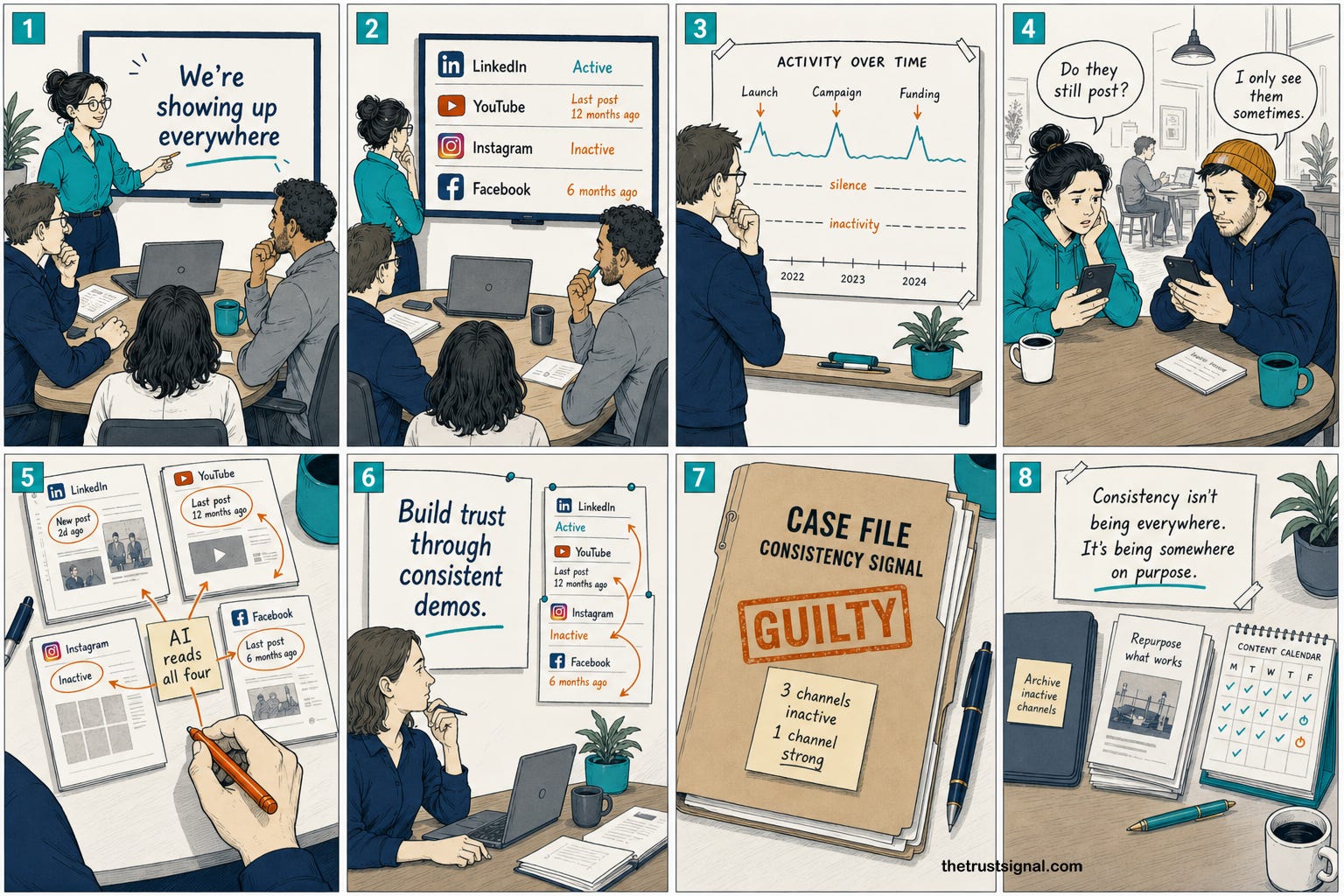
The Consistency signal measures one thing: does this brand show up on a decided rhythm, independent of whether something is launching? The evidence across Walnut’s channels was unambiguous.
YouTube - last post: approximately 12 months ago
A channel that was once active enough to build a following has gone silent for approximately a year. For a product that sells through demonstration whose entire value proposition is the power of the interactive demo an abandoned YouTube channel sends a signal that is difficult to read as anything other than: we stopped showing up here.
Instagram - last post: August 2023
Nineteen months of silence on a channel that remains publicly visible. Every month of silence is a data point the algorithm reads. Not as absence, as evidence of a brand that was present and then wasn’t. That transition is the signal.
Facebook - last post: September 2024
More recent than the others but still representing six months of silence. The pattern across three channels is consistent: activity, then quiet.
LinkedIn - active, 18,231 followers
Walnut’s LinkedIn presence is genuinely strong. The content is good, the follower count is significant, and the posting frequency is consistent. This is where the brand lives. But LinkedIn alone does not constitute a consistent brand presence, it constitutes a consistent presence on one channel while the others go dark.
The pattern across four channels is not random. It is the Bad Boyfriend brand, charming and present in one place, absent in others. Active when something is launching, quiet when it isn’t. The audience learns this pattern. So does the algorithm.
TRUST SIGNAL CASE FILE #A001 - EXHIBIT 3
The Pattern - Where It Comes From
This pattern is not unusual for a B2B SaaS brand at Walnut’s stage. The company has raised $56M in total funding across multiple rounds, with a $35M Series B in January 2022 representing the last major round - a period when content investment typically peaks. The LinkedIn channel reflects that investment well.
What often happens after a funding round is that content resources concentrate on the channels that directly support pipeline generation. For B2B SaaS, that is LinkedIn and content marketing. YouTube, Instagram, and Facebook become secondary maintained until they aren’t.
The result is a brand that reads as consistent on the channel its sales team uses and inconsistent everywhere else. For a human buyer who encounters Walnut through LinkedIn, this is invisible. For an AI system reading the brand’s behavior across all publicly observable channels, the inconsistency is legible.
AI doesn’t only read the channels you’re investing in. It reads all of them.
The irony for Walnut specifically is pointed. The brand’s core product promise is that consistent, personalized, on-demand demos build trust with buyers. The brand’s own channel behaviour demonstrates the opposite of that promise across three of its four content channels.
That gap between what the brand sells and what the brand signals is not dishonesty. It is the natural drift that happens when content resources are allocated strategically rather than holistically. But AI systems read the drift as evidence, not as context.
TRUST SIGNAL CASE FILE #A001 - EXHIBIT 4
The Verdict
VERDICT: GUILTY The Consistency signal is broken across three of four content channels.
The finding is specific: Walnut’s Consistency signal is broken on YouTube, Instagram, and Facebook. It is strong on LinkedIn. The brand has not decided to be inconsistent, it has concentrated its presence and left the other channels to go dark without acknowledging or closing them.
The cost of this pattern is not visible in sales data. It is visible in AI recommendation confidence. A brand that AI systems can observe going silent on multiple channels is a brand whose behavioral patterns don’t fully add up to a consistently present, reliably trustworthy source. The product reviews and G2 ratings compensate significantly, but they compensate for a signal that could be stronger with relatively low effort.
TRUST SIGNAL CASE FILE #A001 - EXHIBIT 5
The Repair - Three Options, One Decision
The repair for a broken Consistency signal is always a decision, not a campaign. Walnut has three options. Each is legitimate. Only one is currently being executed.
01 Decide and close
If YouTube, Instagram, and Facebook are not channels Walnut intends to maintain, close them intentionally. An archived or closed channel sends a cleaner signal than an abandoned one. The audience understands a brand that says ‘we’re not here.’ They are confused by a brand that is here but silent.
02 Decide and repurpose
LinkedIn content is already being produced. Repurposing it systematically to YouTube, Instagram, and Facebook requires less effort than creating new content for each channel. A LinkedIn post becomes an Instagram caption. A webinar clip becomes a YouTube short. The content exists, the distribution decision doesn’t.
03 Decide and recommit
If Walnut’s team has the capacity to return to these channels properly, a recommitment with a decided cadence, not a burst of activity but a sustainable rhythm, rebuilds the Consistency signal over time. The key word is decided. Posting twice a week on Instagram and actually doing it for six months is worth more than posting daily for three weeks and going quiet again.
The decision is which of these three options matches Walnut’s actual capacity. The wrong answer is to do none of them, to leave the channels as they are, visibly abandoned, sending a signal nobody decided to send.
Consistency isn’t about being everywhere. It’s about being somewhere on purpose.
TRUST SIGNAL CASE FILE #A001 - EXHIBIT 6
The Observation - What This Audit Cannot Tell You
This audit examined the Consistency signal only. It is one of four signals The Trust Signal Diagnostic investigates.
From the outside, Walnut’s Clarity signal appears strong - the homepage communicates what the product does, who it’s for, and what to do next with reasonable efficiency. The Credibility signal appears well-supported by review platforms, case studies, and named clients. The Connection signal is not assessable from publicly observable data alone.
What this audit cannot tell you is whether the Consistency problem is interacting with the other signals in ways that are costing Walnut AI recommendation confidence it doesn’t know it’s losing. That question requires the full diagnostic - access to internal data, a conversation about what the brand is trying to achieve, and a sequenced repair roadmap that addresses all four signals in the right order.
What it can tell you is this: a brand whose product promise is built on the power of consistent, personalized presence has an observable Consistency signal problem on three of its four public channels. That gap is worth closing, not because someone noticed, but because AI systems are noticing constantly, whether anyone is looking or not.
About this audit
This is a free Trust Signal Audit, a snapshot of one signal, based on publicly observable evidence. It is not a full Trust Signal Diagnostic. The diagnostic is a complete investigation into all four signals, conducted with the brand directly, resulting in a sequenced repair roadmap.
If you’d like to understand what your brand’s trust signals are currently saying, to your audience and to the AI systems your ideal clients use to find recommendations, reach out to The Trust Signal.
The investigation is open. The evidence is already there.